
Two rolls, same green, same supplier, and one costs nearly twice the other. The difference is not snake oil, but it is also not worth it everywhere. This is the comparison we get asked for most by buyers choosing between a decorative 3D turf and a plain landscaping roll — what you actually pay for, what you do not, and how to tell which one your project needs in under five minutes.
If you are still working out what "3D" means in the first place, read what 3D artificial grass actually is first. The short version: either curled yarn that springs back, or a geometric pattern tufted through the pile.
The one-line difference
Standard turf is a flat field of straight fibres. It is cheap, it covers ground, and it looks convincing from three metres away. 3D turf is built to be looked at from one metre — either because the yarn holds the pile upright, or because the surface carries a pattern that only works if the pile is dense and even.
Everything else in this comparison follows from that. If nobody will stand close to the surface, you are paying for detail nobody sees.
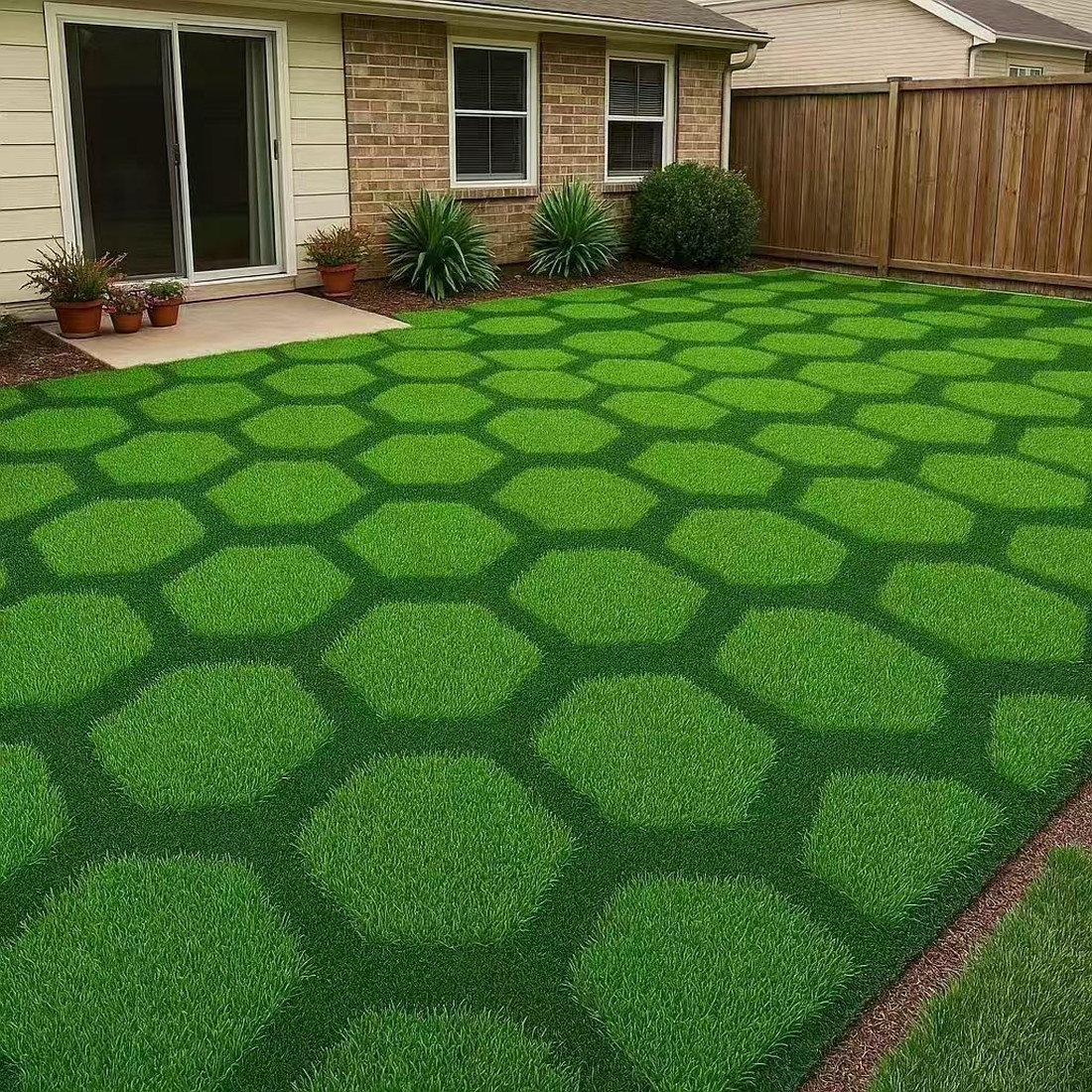
A hexagon pattern 3D turf on a patio. At this distance the repeat is the whole design; on a 200 m² lawn the same turf would read as busy.
Cost, side by side
Retail numbers, per square metre, excluding base preparation and labour.
| Line | Typical price | Pile | Realistic outdoor life | Best use |
| Budget standard turf | $8–12 / m² | 20–30 mm, straight yarn | 3–5 years | Rental-grade cover, temporary |
| Mid standard landscaping turf | $12–18 / m² | 30–35 mm, mixed yarn | 6–10 years | Family lawns, large areas |
| 3D yarn landscaping turf | $16–24 / m² | 25–40 mm, curled underlayer | 8–15 years | Balconies, small lawns, heavy traffic |
| 3D printed pattern turf | $17–22 / m² | 10–50 mm, two-tone pattern | 3–5 years | Courtyards, terraces, events, screening |
Our own curved pattern 3D roll retails at $17.99/m² for a single square metre, with tiered pricing at 50 m² and 100 m² and trade rates on the wholesale page. A plain 30 mm landscaping roll lands roughly 30–50% below that.
The number that usually gets missed: on soil, the base costs more than the difference in turf price. Thirty to fifty millimetres of compacted crushed stone plus a membrane runs $15–30/m² depending on access. Choosing the cheaper roll and skipping the base is the single most expensive mistake in this category — the turf fails in eighteen months and you pay for the base anyway.
Looks: where 3D wins and where it is wasted
3D yarn wins on resilience, not on colour. The curled fibre props the pile up, so the surface recovers after furniture, footfall and rain. Standard turf develops a grain — a visible direction where the fibres have laid over — and once it does, no amount of brushing gets it back. On a balcony where four chairs and a table sit in the same place for years, that difference is the whole product.
3D patterns win on design intent. A geometric repeat signals that someone chose the surface. On a courtyard, a wedding aisle, a shop display or a themed playground, plain turf looks like the cheap option and pattern turf looks like the specified option.
Pattern loses on scale. Above roughly 100 m² the repeat dominates and the space starts to look like a hotel lobby. Below about 8 m² a large motif can look cropped. The sweet spot is 10–60 m² — a courtyard, a terrace, a feature zone inside a bigger garden.
Wear: what actually breaks first
Not the yarn. In order of frequency, these are the real failure modes:
| Failure | Cause | Which turf suffers more |
| Matting and grain | Straight fibres crushed by traffic and furniture | Standard turf, badly |
| Seam lift | Adhesive applied cold, wet or on a dusty edge | Both equally |
| Ponding | Backing with insufficient perforation, or no fall on the base | Both equally |
| Edge curl | Too few pins, or pins set too far from the edge | Both equally |
| UV fade | Unstabilised yarn in unshaded sun | Cheap pattern turf, most |
| Pattern scuffing | Surface-printed (not tufted) patterns | Surface prints only |
Two of those six are turf-quality problems. Four are installation problems. That ratio is why we spend more words on base preparation than on fibre: a mid-range roll on a good base outlives a premium roll on a bad one, every time.
Heat and comfort
Synthetic surfaces get hot in direct sun, and 3D turf is no exception. Denser pile holds marginally more heat because there is more surface area; lighter two-tone yarns and a lower pile run slightly cooler than a deep 40 mm pile. Neither type is cool underfoot at 2 pm in August.
Practical mitigations, in order of effectiveness: shade, a light rinse before barefoot use, and choosing 20–30 mm rather than 40 mm for a terrace you actually walk on barefoot. If heat is your main concern rather than appearance, our ten-year cost comparison against a real lawn covers the trade-off honestly.
Pets, kids and bare feet
For a pet corner, plain mid-range turf is the sensible buy: it drains, it hoses down, and when a section is destroyed you replace a square metre cheaply. Pattern turf works but the value is aesthetic, and repairing a pattern means matching the repeat at the seam.
For kids, 3D yarn at 30 mm is the better surface — the curled underlayer gives more cushioning than the same height in flat fibre, and it does not compact into a hard mat under a swing or a slide.
Maintenance: almost identical
Brush against the pile once a month. Rinse two or three times a season. Remove leaves before they break down. Both types need the same routine, with two 3D-specific cautions:
Never pressure-wash a printed pattern at close range — it frays the fibre tips and leaves a pale patch. And do not use a stiff wire broom on curled yarn; it pulls the curl out of the underlayer and the pile never recovers its spring.
How to decide in five minutes
Answer these in order and stop at the first "yes".
1. Is the surface larger than 100 m²? Buy standard landscaping turf. Pattern buys you nothing at that scale.
2. Is it a sports surface? Buy neither — you need tested sports turf, and decorative product is not specified for ball roll or shock absorption.
3. Will people see it from under a metre, as a design feature? Buy 3D pattern. Courtyard, terrace, event floor, shop display, screening panel.
4. Is it a small space with furniture and heavy footfall? Buy 3D yarn. Balcony, small city garden, roof terrace.
5. None of the above? Buy good mid-range standard turf and put the savings into the base. That is the honest answer for most back gardens.
Mixed approach: the one we recommend most
For a garden with a lawn plus a terrace, do not pick one product. Put standard 35 mm turf on the lawn and a 3D pattern on the terrace or the feature strip. The pattern reads as deliberate because it is bounded by paving, the plain turf keeps the large area calm, and the total cost sits between the two single-product quotes.
It is also the easiest way to test the category: order a square metre of each, leave them in the sun for a fortnight, and walk on them barefoot. Both our garden turf and the patterned range are sold from 1 m², and we send a free 1 m² sample with wholesale enquiries.

The other half of the comparison: a plain-cut lawn reads calm at scale, and costs a third less. Most gardens need this, plus a small patterned zone.
What we would tell a friend
3D turf is not a better product, it is a more specific one. It solves two problems — a surface that must stay upright in a small space, and a surface that must look designed — and it charges for both. If neither problem is yours, spend the difference on the base and the edges, where the money actually shows.