
Search for 3D artificial grass and you will find two completely different products under the same name. One is turf built from curled, three-dimensional yarn that stands up instead of flattening. The other is turf with a geometric pattern printed through the pile — hexagons, diamonds, circles, curved waves. Both are sold as "3D", both photograph beautifully, and both behave very differently once they are on the ground.
This guide separates the two, explains which specifications actually control how a 3D turf looks and wears, and tells you where each type is worth the extra money. If you are still deciding whether artificial grass suits your space at all, start with our full buyer's guide to choosing artificial grass and come back here for the 3D specifics.
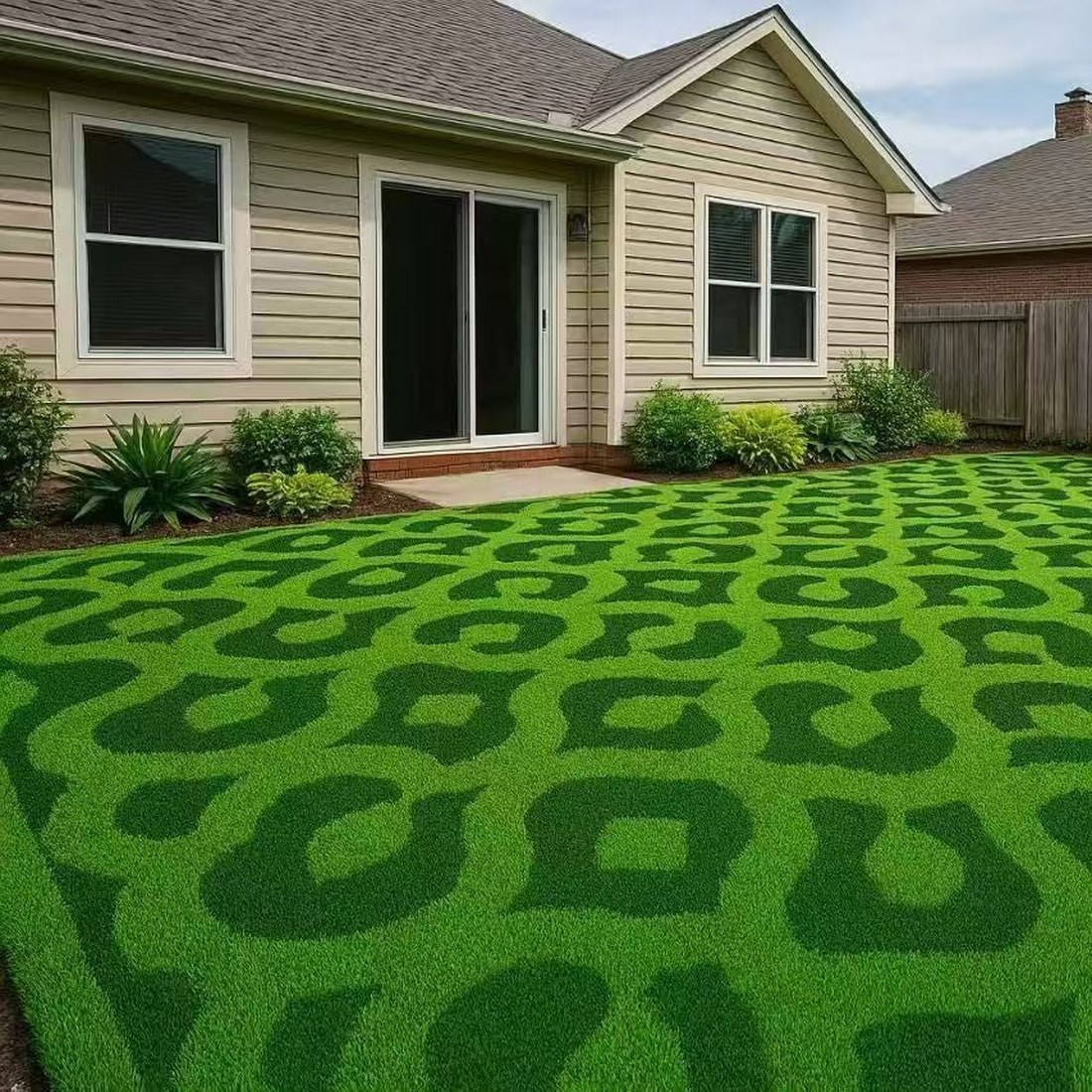
A 3D printed curved pattern turf across a back garden. The pattern is tufted through the pile, so it reads as depth rather than a printed surface.
The word "3D" covers two different products
1. 3D yarn: curled fibre that holds the pile upright
In traditional turf, every blade is a straight monofilament. It looks fine on the roll and flat within weeks — foot traffic, furniture legs and rain push the fibres over, and the surface develops a direction and a sheen that gives away the plastic.
3D yarn adds a second fibre: a curled, crimped or "memory" yarn tufted in among the straight blades. The curl acts like a spring. It props the straight fibres up from underneath, so the pile recovers after being compressed instead of staying flattened. The effect is a surface that looks denser and taller than its measured pile height, holds a matt, non-directional finish, and hides footprints and chair marks far better.
You will see this described as curly yarn, memory yarn, C-shape or S-shape fibre, or "3D structured" pile. It is the technology behind most premium landscaping turf and most good balcony turf.
2. 3D printed patterns: geometry tufted into the pile
The second product is a decorated turf. Instead of a uniform green, the tufting machine lays down a repeating geometric motif — hexagon, diamond, circle, oval, wave — in two tones of green. The pattern sits in the pile itself, through the full pile height, not on the surface.
That distinction matters more than anything else on the spec sheet. A surface print is ink on top of plastic: it scuffs, fades and peels from the first season. A pattern tufted into the pile survives brushing, rain and foot traffic because there is nothing to wear off — the darker motif is simply a different yarn laid in a different place.
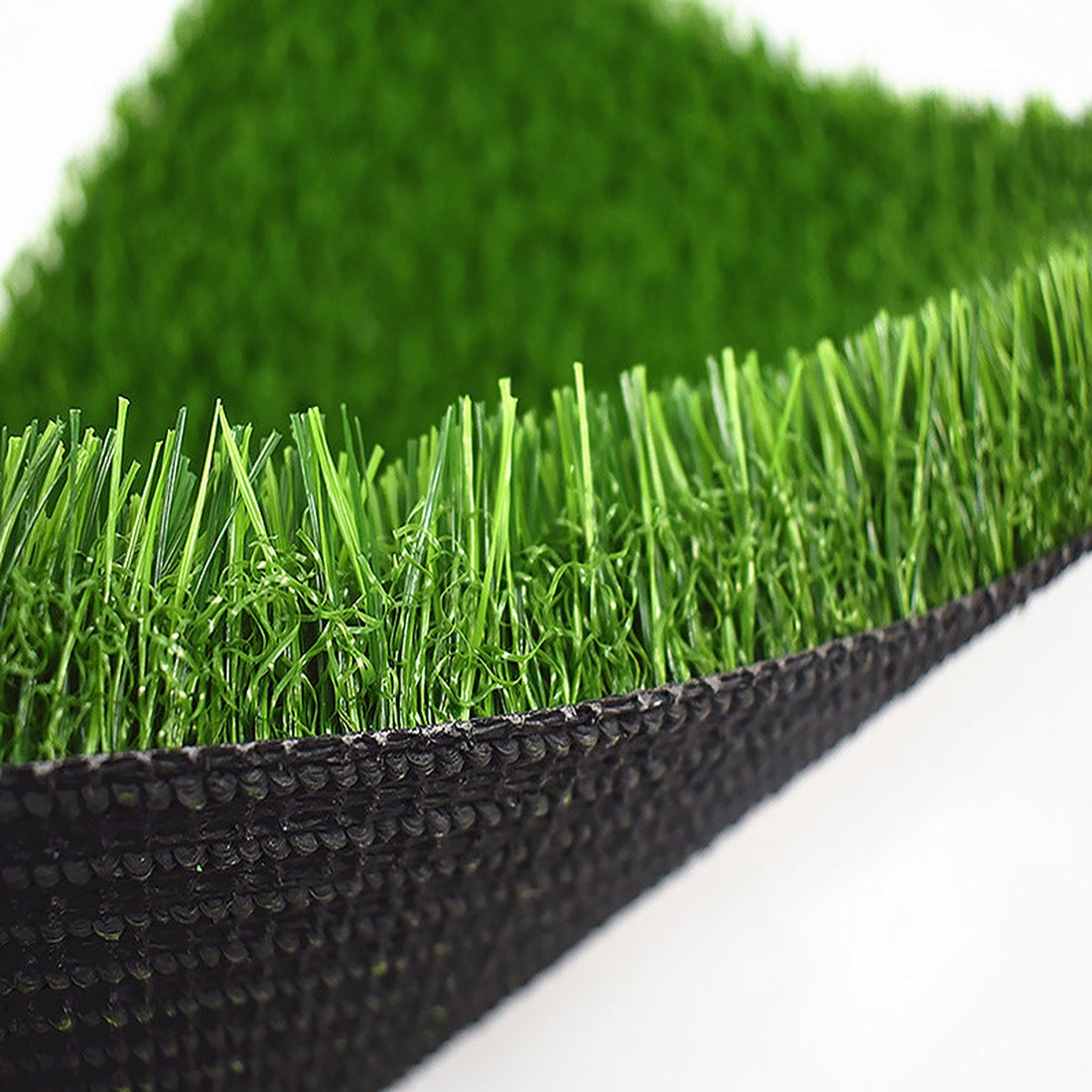
A cut edge tells you more than any product photo: dense upright pile, a two-tone face, and a perforated PP backing that lets water straight through.
What actually makes turf look three-dimensional
Five things, in descending order of impact. Sales pages tend to lead with the least important one.
| Factor | What it does | What to look for |
| Yarn shape | Determines whether the pile springs back or mats flat | Curled or memory yarn mixed with straight monofilament |
| Pile height | Controls visual depth and cushioning, not density | 20–30 mm for patios and balconies, 30–40 mm for family lawns |
| Stitch density | Controls how much backing you can see through the pile | Look at the turf at a low angle, not from above |
| Colour mix | Breaks up the flat single-green look | Two or three tones of green, plus a brown thatch curl at the base |
| Backing | Holds the tufts and decides drainage | PP woven cloth with perforations, 60+ L/min/m² drainage |
Pile height is the number buyers focus on and the one that matters least on its own. A 40 mm turf with sparse stitching looks thinner than a 25 mm turf with tight stitching and a curled underlayer, because what your eye reads is the ratio of green to backing. That is why a well-made 3D turf at 25 mm can look deeper than a cheap 40 mm roll.
The specifications that survive contact with reality
Four numbers are worth checking before you buy, and one of them is usually missing from the listing.
Dtex measures yarn weight per 10,000 metres. Landscaping turf typically runs 6,000–13,000 Dtex. Higher means thicker individual fibres and better resistance to flattening, but only when the stitch rate holds up.
Face weight is grams of yarn per square metre — usually 1,000–2,500 g/m² for landscaping. This is the honest density figure. Below about 1,100 g/m² the backing starts showing through at low angles.
Gauge and stitch rate together set how many tufts per square metre. A 3/8" gauge with a high stitch rate beats a 5/8" gauge with a low one for a dense look, at the cost of more material and more money.
Drainage rate is the one listings hide. Perforated PP backing should pass well over 60 L/min/m². On a balcony or a roof terrace with nowhere for water to go, this number is the difference between a usable surface and a paddling pool.
Where 3D turf earns its price
Balconies and roof terraces. Small areas are seen up close and from above, so pattern and density read immediately. A 20 mm printed pattern turf on a 6 m² balcony looks intentional; a cheap 40 mm plain roll looks like carpet. Our circle pattern 3D turf is built for exactly this — 20–30 mm pile, cut to size, light enough to lift.
Courtyards and feature areas. Where a plain lawn would look flat against paving, a geometric pattern gives the eye something to land on. The hexagon pattern and diamond pattern versions are the two that photograph best and hide seams most easily, because a regular repeat is simple to line up.
Events and temporary installs. Weddings, marquees and product launches need a floor that reads as designed rather than borrowed. Patterned turf rolls out fast, needs no infill, and the pattern hides the seam lines that plain turf exposes under event lighting.
Playgrounds and themed spaces. The 3D yarn type is the better choice here — 30 mm with a curled underlayer gives cushioning for falls without the cost of a wet-pour surface, and it does not turn to mud.
Screening walls and vertical surfaces. Pattern turf on a fence panel or a privacy screen reads as a design feature rather than a camouflage attempt.
Where it does not
Large open lawns. Above roughly 100 m², a strong geometric repeat starts to look like wallpaper, and the price premium buys you nothing a good 35 mm landscaping turf would not deliver. Use the garden turf range for that.
Sports surfaces. Football, hockey and golf need tested ball roll, spin and shock absorption. Decorative pattern turf is not specified for it, and no amount of 3D yarn changes that.
Heavy dog runs. Patterned turf works for a pet corner, but a dedicated run needs a drainage-first build-up and a turf rated for it. See the pet-friendly turf instead.
What 3D turf costs
Decorative 3D turf sits above standard landscaping turf and below sports turf. Retail on our patterned range starts at about $17.99 per square metre for a single square metre, dropping on 50 m² and 100 m² tiers; wholesale pricing for trade buyers is on the wholesale page. Standard 30 mm landscaping turf typically lands 30–50% cheaper per square metre.
Budget for the base as well. On a patio or balcony that means a few millimetres of levelling and a membrane, which is cheap. On soil it means 30–50 mm of compacted crushed stone and a weed membrane, which frequently costs more than the turf itself. Our installation guide walks through the build-up in detail.
How long it lasts, honestly
Be sceptical of any decorative pattern turf advertised at fifteen years. Patterned and budget-priced 3D lines generally carry an outdoor rating in the 3–5 year range, and in strong UV that is realistic. Premium landscaping turf with UV-stabilised yarn and a proper backing reaches 8–15 years.
What kills these surfaces is rarely the yarn. It is UV fade from unshaded sun, a backing that fails because water could not drain, or a seam that lifted because the adhesive was applied cold. All three are installation and specification problems, not material ones.
If long life in full sun is the priority, ask for UV-stabilised yarn and a flame-retardant option, and read the warranty terms rather than the marketing line.
Maintenance is not zero, but it is small
Brush against the pile direction once a month with a soft stiff brush to lift fibres that traffic has pushed over. Rinse the surface two or three times a season — more if it is under trees. Pick up leaves before they break down into the pile. That is the whole routine, and it holds whether the turf is 3D yarn or a printed pattern.
The one rule specific to printed patterns: never pressure-wash the face. A pattern tufted into the pile is durable, but a 150-bar jet at close range will fray the fibre tips and leave a pale patch you cannot repair.
The short version
If you want a surface that stays upright and looks dense in a small space, buy 3D yarn. If you want a surface that reads as a design decision — a courtyard, a balcony, an event floor — buy a 3D pattern. If you have a large lawn and a normal budget, buy neither and put the money into a better base.
Next: how 3D turf compares with standard turf on cost, looks and wear, and how to install it without wrecking the pattern.