
For a 100m² garden, ten years of natural grass costs somewhere between $11,700 and $38,700. The same area in artificial grass costs $4,600 to $12,300 — and about 90% of that difference is water, mowing and fertiliser, not the turf itself. That is the honest version of the comparison. Below is the arithmetic, line by line, including the parts the artificial turf industry prefers to leave out: hot surfaces, rinsing, and the cost of replacing the carpet in year ten.
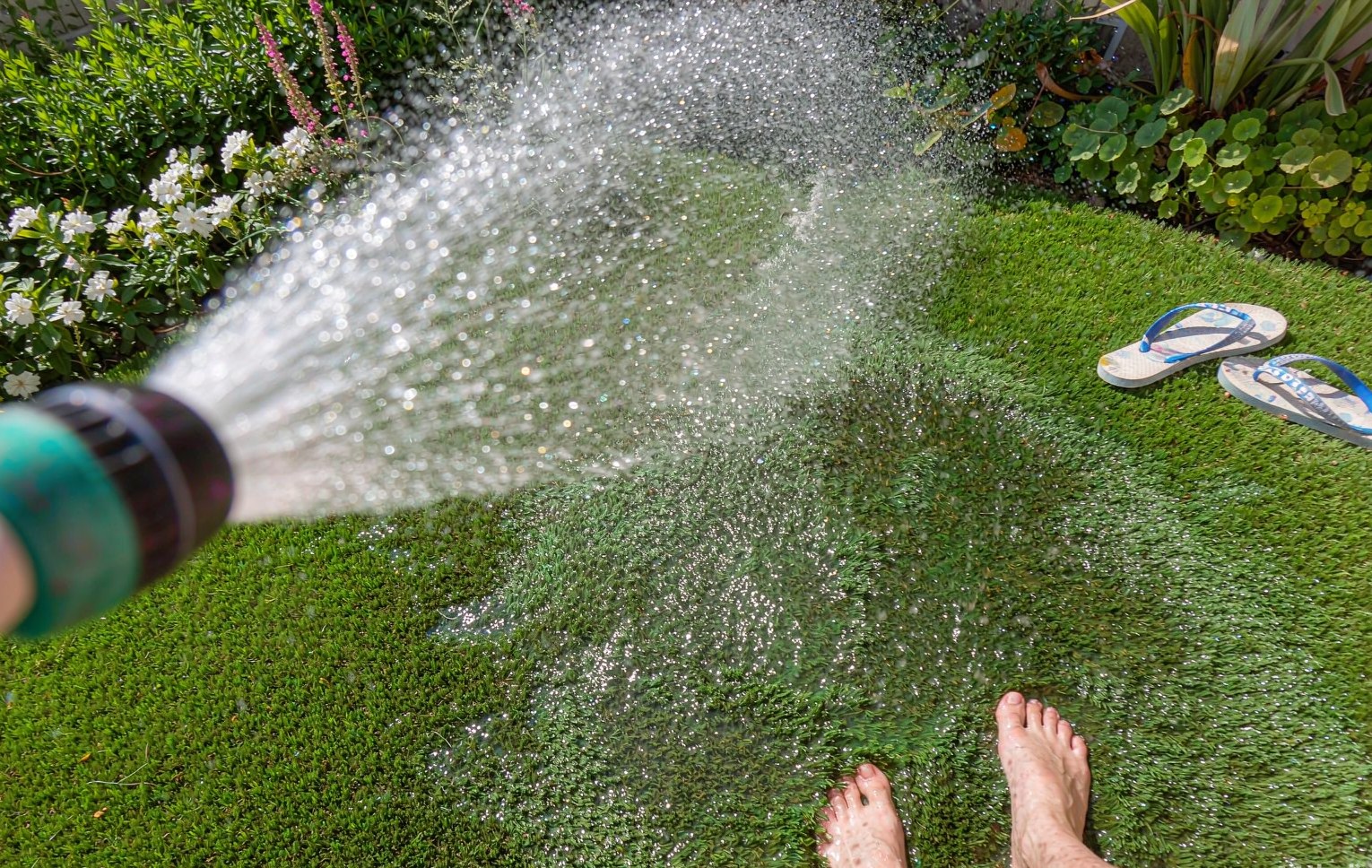
Artificial grass uses water too — for cleaning, cooling and pet hygiene. It is a fraction of irrigation, but it is not zero.
The headline numbers
| Natural grass | Artificial grass | |
|---|---|---|
| Upfront cost, 100m² | $2,100–6,200 | $3,500–8,300 |
| Annual running cost | $960–3,250 | $110–400 |
| Maintenance time per year | 30–45 hours | 4–8 hours |
| Water per year | 30–200m³ | 1–4m³ |
| 10-year total | $11,700–38,700 | $4,600–12,300 |
| 15-year total (with replacement) | $17,500–58,000 | $6,350–17,000 |
Two caveats before the detail. First, these are homeowner numbers for a domestic garden, not a sports facility — a full-size pitch behaves completely differently, and we have covered that separately in the 10-year cost of a football pitch. Second, ranges are wide because water price and labour cost vary by a factor of five between, say, Phoenix and Manchester.
Upfront cost: what each surface costs to build
| Line item | Natural grass (100m²) | Artificial grass (100m²) |
|---|---|---|
| Ground preparation | $600–1,800 (rotovate, level, topsoil) | $1,200–2,800 (excavate, 75mm compacted stone, bedding) |
| Surface | $300–900 (seed, or sod at $5–9/m²) | $1,000–2,200 (turf at $10–22/m²) |
| Irrigation | $1,200–3,500 (sprinkler system) or $100–300 (hose and sprinkler) | Not required |
| Edging and fixing | $0–300 | $300–800 (timber, steel or concrete edge, pins, adhesive) |
| Install labour | $0–600 | $1,000–2,500 (or $0 if DIY) |
| Total | $2,100–6,200 | $3,500–8,300 |
The artificial quote looks 60–100% higher, and it is. Two things are worth noting. The premium is mostly stone and labour, not carpet: turf is typically only 25–35% of an installed artificial garden. And a seeded lawn is not usable for two to four months, with a real chance of having to overseed if the weather turns — a cost that never appears in the comparison table.
Running costs, year by year
| Annual item | Natural grass | Artificial grass |
|---|---|---|
| Mowing | $600–1,800 (26–35 cuts; or 20–26 hours of your own time) | None |
| Water | $90–500 (see the water section below) | $15–60 (rinsing and cooling) |
| Fertiliser | $80–250 | None |
| Weed, moss and pest control | $50–200 | $0–50 (edges and seams only) |
| Aeration and top dressing | $80–250 | None |
| Overseeding and bare-patch repair | $60–250 | $0–50 |
| Brushing, leaf clearing, sanitising | Included in mowing | $0–80 (your own time) |
| Infill top-up (filled systems only) | — | $30–60 averaged |
| Seam and edge repair | — | $30–100 |
| Total per year | $960–3,250 | $110–400 |
The maintenance gap is real, but it is not the 10:1 that sales decks imply — call it $1,600 against $250 at the midpoint. The number that actually changes behaviour is the hours: 30–45 hours a year of mowing, edging and weeding against 4–8 hours of brushing and rinsing.
Water: the line that decides it in a dry climate
One millimetre of irrigation over one square metre is one litre. So the useful way to think about a lawn is in millimetres per year of applied water:
| Climate | Irrigation applied | Water per 100m² | Annual cost |
|---|---|---|---|
| Temperate (UK, northern Europe, Pacific Northwest) | 300–600mm | 30–60m³ | $45–180 |
| Warm temperate (southern Europe, coastal California, Sydney) | 700–1,000mm | 70–100m³ | $140–400 |
| Arid (Gulf, Arizona, inland Australia, South African highveld) | 1,400–2,000mm | 140–200m³ | $200–600+ |
At the midpoint of a temperate climate this is a minor bill. In an arid one it is a second water account: a 200m³ lawn in a city charging $3/m³ costs $600 a year, and in some drought-affected regions it is simply not permitted — several municipalities in the US southwest, Australia and the Gulf now restrict or ban ornamental lawn irrigation during restrictions, which is a reliability problem before it is a cost problem.
Artificial grass uses water for cleaning, not for growth: roughly 1–4m³ a year for a 100m² garden, and a little more in summer if you rinse the surface to cool it. Compared with 140–200m³, that is a 97–99% reduction — and it is the single strongest argument for turf in hot markets.
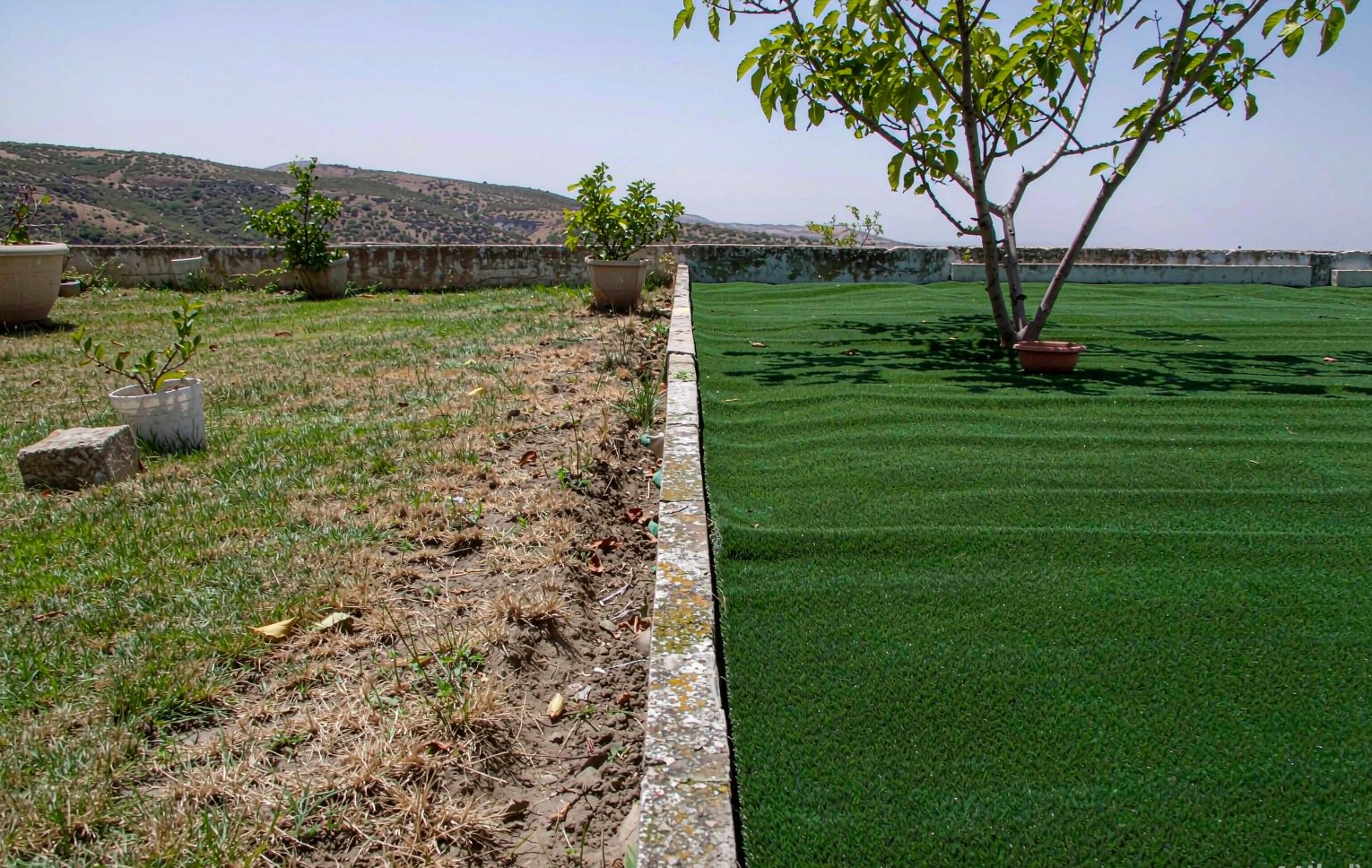
The same garden, same week, same water restriction. Left: natural grass under deficit irrigation. Right: artificial turf.
Hot climates: where the case is strongest
Three regions come up in almost every enquiry we get, and each has a slightly different logic.
Middle East
Summer surface temperatures on unshaded artificial turf can pass 60°C, so cooling is a genuine design requirement — but the alternative is worse. Keeping a natural lawn alive through a Gulf summer means 1,800mm+ of irrigation, usually desalinated, on soil that is often sand with almost no water-holding capacity. Most residential projects there now specify artificial turf for exactly this reason, with a light-coloured infill and a shading plan for the hottest months.
South Africa
Water tariffs in metros like Cape Town and Johannesburg have risen sharply and restrictions are now routine. A lawn that survives a level-2 restriction looks like the left-hand side of the photo above. Artificial turf removes the lawn from the restriction conversation entirely, which is why estate and rental developments specify it for common areas.
Southern United States
States like Arizona, Nevada, Texas and Florida combine heat, high evapotranspiration and, in several cities, direct rebates for removing lawn. HOA rules are the usual obstacle — check them before ordering, because some associations still require a minimum percentage of live vegetation, and a few now explicitly permit artificial turf if it meets a colour and pile specification.
Children, pets and allergies
This is the part of the comparison that rarely makes it into a spreadsheet, and often decides the purchase.
- Pollen: a natural lawn produces grass pollen through the mowing season. Artificial turf produces none. For a household with hay fever or a grass allergy, that alone can be decisive.
- Mud: a natural lawn in a wet climate is mud from October to March, and mud comes indoors. Artificial turf drains and stays walkable — provided the base was built properly, which is the subject of our installation guide.
- Chemicals: fertiliser, herbicide and moss treatment all disappear, which matters with toddlers and dogs on the surface daily.
- Wear: a natural lawn used by two dogs and three children in a 60m² garden will not stay grass. It becomes a mud track with grass at the edges. Artificial turf at 25–30mm with a perforated backing handles that load without changing appearance.
The real disadvantages — the part most comparisons skip
Artificial grass is not a free upgrade. These are the genuine drawbacks, and they should be in the decision.
- Surface temperature. In direct summer sun, artificial turf runs 15–25°C hotter than the air, and 20–30°C hotter than natural grass. In Gulf or Arizona summers that can mean 60–70°C underfoot. It is not a barefoot surface at 2pm in July, and it does heat the air immediately above it.
- It still needs cleaning. Leaves, dust, pollen and bird droppings do not decompose into the surface. Budget brushing and an occasional rinse; in dusty regions, more often than you expect.
- Pet hygiene is a routine, not an event. Urine needs diluting and rinsing, solids need removing promptly, and a perforated backing plus a draining base is what makes that possible.
- Microplastics and end-of-life. Turf sheds fibre fragments and infill over its life, and the carpet has to be disposed of at year 10–15. Not every region has a facility that will take it — ask before you buy, not in year twelve.
- It does not cool the garden. Natural grass transpires and lowers local air temperature by a few degrees. Artificial turf gives that up.
- Weeds still arrive. Not through the turf, but at the edges, in the joints and in any gap where soil meets the backing. Edging and a weed membrane solve most of it.
Ten-year and fifteen-year totals
| Natural grass | Artificial grass | |
|---|---|---|
| Upfront | $2,100–6,200 | $3,500–8,300 |
| Running costs, 10 years | $9,600–32,500 | $1,100–4,000 |
| Renovation (natural) / replacement (artificial) | $1,000–3,000 (scarify, re-seed, re-level) | $0 inside 10 years, $1,000–2,200 at year 10–12 |
| 10-year total | $11,700–38,700 | $4,600–12,300 |
| 15-year total | $17,500–58,000 | $6,350–17,000 |
At the midpoint, ten years of natural grass costs about $19,500 and ten years of artificial turf about $6,000. That $13,500 gap is the whole case, and it survives being questioned line by line — provided the artificial install was done properly. If the base was not built, the turf will pond, wrinkle or lift at the seams within three years, and the calculation collapses.
When natural grass is still the right choice
It would be dishonest to pretend turf wins everywhere. Choose natural grass when:
- Water is cheap and plentiful and your climate is cool and wet. In parts of the UK, Ireland, the Netherlands and New Zealand, a lawn grows itself.
- Usage is light. A small, ornamental lawn that nobody walks on does not wear out.
- You want the garden ecology. Soil, worms, insects and the cooling effect are real benefits that artificial turf does not replace.
- Planning or HOA rules require live vegetation. Some jurisdictions do.
Which one should you buy?
| Your situation | Better choice | Why |
|---|---|---|
| Dry or drought-restricted climate | Artificial | 97–99% less water; the lawn stays green through restrictions |
| Dogs and young children | Artificial | No mud, no bare patches, no chemicals |
| Small garden, heavy use | Artificial | Natural grass fails under that load; turf does not |
| Grass pollen allergy in the household | Artificial | No pollen production |
| Cool, wet climate with cheap water | Natural | Low running cost, and the ecology is a genuine benefit |
| Large ornamental lawn, light use | Natural | Artificial capital cost never gets repaid |
| Rental property, minimal maintenance | Artificial | Predictable cost, no contractor visits, no tenant mowing disputes |
If it is artificial, the specification matters more than the brand: 30–35mm, at least 10,000 dtex, 18,000+ stitches per square metre, a perforated double backing, and a tested UV package. The buyer's guide walks through each number and the price bands they sit in.
Frequently asked questions
Is artificial grass cheaper than real grass over 10 years?
For a 100m² domestic garden, yes — typically $4,600–12,300 against $11,700–38,700, at midpoints roughly a third of the cost. The saving comes from water, mowing, fertiliser and repairs, not from the turf being cheaper to buy.
How much water does artificial grass save?
About 97–99% of irrigation. A natural lawn takes 30–200m³ a year depending on climate; artificial turf uses 1–4m³ for cleaning and cooling.
Does artificial grass get too hot to walk on?
In direct summer sun it runs 15–25°C above air temperature and can exceed 60°C in extreme climates. A quick rinse drops the surface temperature by 10–20°C for a while; shade and lighter infill also help. It is not a barefoot surface at midday in a Gulf summer.
Does artificial grass need to be replaced?
Yes, eventually. A mid-range garden turf lasts 8–12 years, premium products 12–15. Budget for $1,000–2,200 of material for a 100m² garden at that point, plus disposal.
Can I install artificial grass over my existing lawn?
No. You need to remove the turf and 75–100mm of soil, then build a compacted stone base with a fall. Laying turf over soil or over existing grass is the single most common reason a domestic installation fails within two years.
Work out your own numbers
Send us the garden size, the climate and what the surface is for, and we will come back with a specification and a per-square-metre price you can put straight into this calculation. Get a quote here, or see the garden turf range.