
Four numbers decide whether artificial grass still looks like a lawn in year five: pile height, face weight (or dtex), stitch density, and the backing underneath it. Colour, brand and price per square metre all follow from those four. This guide works through them in the order a buyer should actually ask, gives the specification bands we use when a customer tells us what the surface is for, and explains where the cheap end of the market fails.
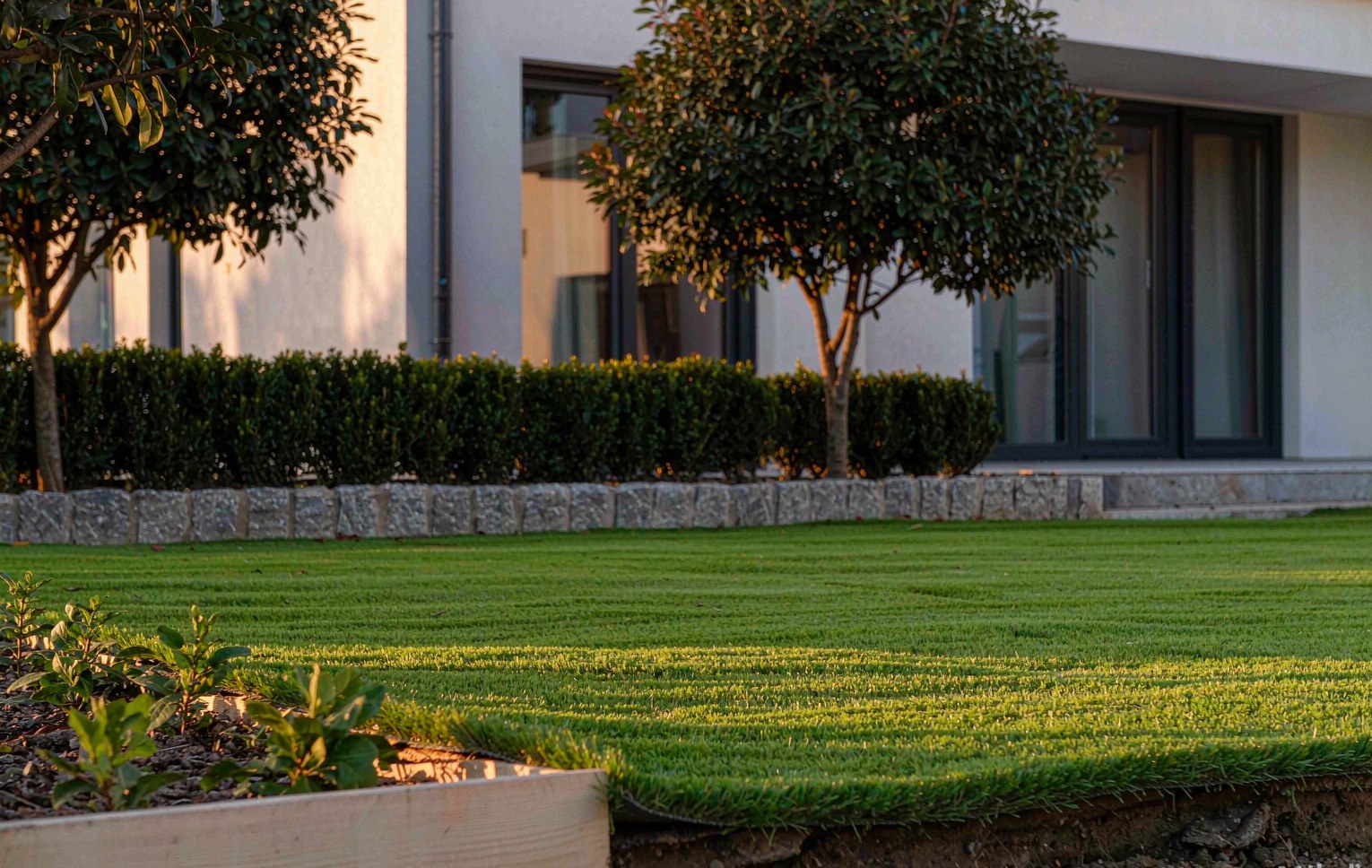
A 35mm garden turf at 11,000 dtex, laid over a properly compacted base. The flat, even pile is a density result, not a height result.
Start with the use case, not the price
Almost every bad artificial grass purchase starts the same way: the buyer compares three rolls at the same pile height and picks the cheapest. Pile height is the one number every factory can hit cheaply, so it is the worst possible basis for a decision.
Start instead with who stands on the surface and how often. That single answer sets pile height, fibre weight, backing and infill before you look at a single price list.
| Use case | Pile height | Dtex | Stitch density | Backing | Infill | Material price |
|---|---|---|---|---|---|---|
| Family backyard (kids, bare feet) | 30–35mm | 9,000–13,000 | 18,000–21,000/m² | Double PP, drainage holes | Optional 5kg/m² silica sand | $10–22/m² |
| Balcony, rooftop, terrace | 20–25mm | 7,000–9,000 | 16,000–19,000/m² | Perforated, lightweight | None | $8–16/m² |
| Pet area / dog run | 25–30mm | 9,000–11,000 | 18,000–20,000/m² | Perforated, PU or latex coat | None, or zeolite | $10–18/m² |
| Sports (5-a-side, school, multi-use) | 40–50mm | 12,000–15,000 | 20,000–24,000/m² | Double PP + mesh | 15–20kg sand (+4–8kg rubber) | $14–28/m² |
| Putting green | 10–15mm | 5,000–8,000 | 22,000/m²+ | Dense, non-perforated | None | $12–25/m² |
| Commercial, hotel, show garden | 35–40mm | 11,000–14,000 | 18,000–21,000/m² | Double PP, drainage holes | Light sand | $14–26/m² |
Backyard: 30–35mm, and density matters more than the millimetres
This is the band that sells most, and it is genuinely the right answer for a family garden. At 32–35mm the turf reads as a well-kept lawn from standing height, feels soft in bare feet, and still cuts cleanly at a path edge.
The trap is buying 35mm at 15,000 stitches per square metre. It looks acceptable in the showroom and looks thin within one season, because there is not enough fibre per square metre for the blades to support each other. At the same height with 20,000 stitches the surface stays upright for years. Ask for both numbers.
Balcony and rooftop: 20–25mm, and check the load
Balconies fail on two things that have nothing to do with appearance. The first is weight: a 40mm turf with a heavy backing and sand infill can add 15–20kg per square metre once it is wet, which matters on a cantilevered balcony or a lightweight roof. The second is cleaning: long pile traps leaves, holds moisture against the slab, and is difficult to lift.
20–25mm perforated turf at 2.5–4kg/m² drains straight through and can be rolled back for cleaning. If the balcony sits over a neighbour, fit a drainage mat underneath as well — the turf is not a waterproofing layer and should never be treated as one.
Pet areas: 25–30mm with a perforated backing
Dogs need three things artificial grass does not provide by default: drainage, odour control and something that survives claws. Specify 25–30mm at 9,000–11,000 dtex with a perforated backing, laid on a base that falls to a drain or a soakaway, not on compacted soil.
Check how the backing is coated. A latex coating is cheaper and fine for gardens, but urine sits in the pile if the drainage holes are small or blocked by adhesive. A PU coating with open holes cleans better. Zeolite infill helps with ammonia, but it is a supplement, not a substitute for rinsing.
Sport: 40–50mm, and never without infill
Sport turf is a system, not a carpet. 40–50mm at 12,000–15,000 dtex accepts a sand and rubber profile that keeps the fibre upright and gives the right ball roll and energy absorption. Installing a 50mm sports carpet dry produces a slow, matted surface that wears out years early — ask about the infill design at the same time as the turf.
Putting greens: 10–15mm for ball roll
Short pile exists for a physical reason: a golf ball rolls true only when there is no fibre tall enough to deflect it. 10–15mm at 22,000+ stitches is the standard. On a hard base it has almost no cushioning, so it is a specialist surface, not a general-purpose lawn.
Pile height: what 20, 30 and 40mm actually do
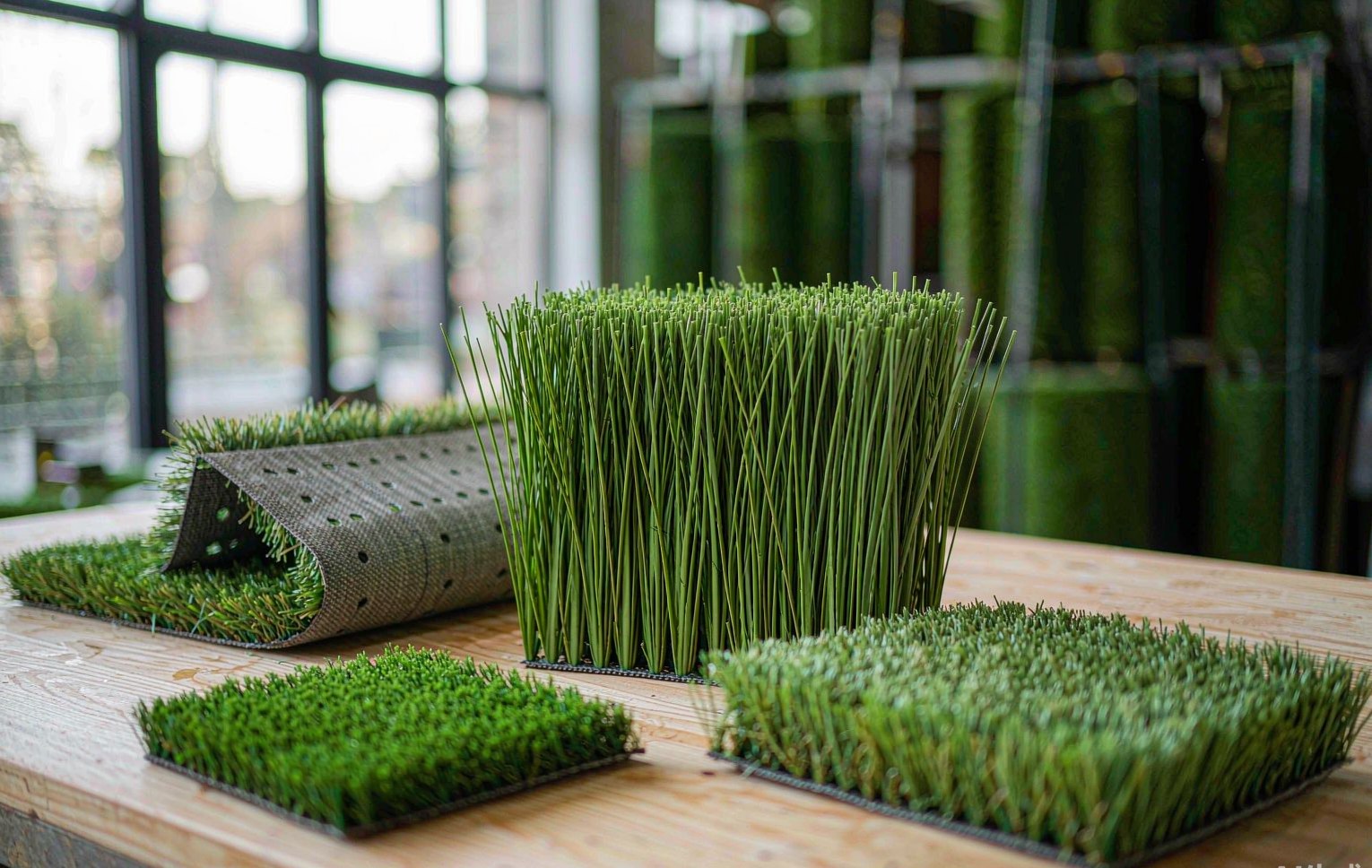
Same colour, same supplier, three pile heights — and one sample turned over to show the perforated backing. The backing is the part buyers never ask about and always regret.
| Height | Feels like | Best for | Watch out for |
|---|---|---|---|
| 20mm | Firm, almost like carpet on a hard base | Balconies, terraces, gyms, pet runs | Shows every dip in the base; looks thin at low stitch counts |
| 30mm | Soft underfoot, natural from standing height | Family gardens, courtyards, play areas | Enormous quality spread at the same height |
| 40mm | Full and springy, hides seams and small unevenness | Premium gardens, hotel grounds, school play | Fibre collapses if dtex is under ~11,000; heavier to handle |
Two clarifications that save arguments later. Pile height is measured from the top of the primary backing to the fibre tip — it excludes the backing, which adds 2–4mm, and the coating underneath. And height does not predict wear: a 40mm turf at 9,000 dtex will flatten into a brushed, directional pile within a season, while a 32mm turf at 13,000 dtex will not.
For the full height-by-height breakdown, including how 10mm and 50mm behave, see our pile height guide.
Face weight, dtex and stitch density: the three numbers behind "thickness"
Buyers ask for thickness because it is the only thing they can feel in a sample. Suppliers answer with pile height because it is the only number they can change cheaply. The numbers that actually describe thickness are these three.
Face weight
Face weight is the mass of fibre per square metre of finished turf, excluding the backing and coating. It is quoted in grams per square metre in most of the world and in ounces per square yard in the US — 1oz/yd² equals roughly 33.9g/m², so a "50oz" turf is about 1,700g/m².
Typical bands:
- 20mm garden and balcony turf: 1,000–1,400g/m²
- 30–35mm garden turf: 1,600–2,200g/m²
- 40–50mm landscape and sports turf: 2,200–2,900g/m²
Face weight is a good sanity check but a poor comparison across suppliers, because it depends on how thick each individual fibre is as well as how many there are.
Dtex
Dtex is the weight in grams of 10,000 metres of a single yarn. It describes the fibre itself: 12,000 dtex means a heavier, stronger blade than 8,000 dtex at the same height. This is the number that predicts whether a long pile stays upright and whether the surface survives dogs, chairs and football boots.
A practical minimum by height: 7,000 dtex at 20mm, 9,000 dtex at 30mm, 11,000 dtex at 40mm, 13,000 dtex at 50mm. Below those figures the pile leans and stays leaning.
Stitch density
Stitch density is how many stitches per square metre, and it is calculated from two figures on the spec sheet: gauge (the distance between rows) and stitch rate (stitches per 10cm).
Stitches per metre × rows per metre = stitches per m². A 3/8" gauge gives 105 rows per metre. At 14 stitches per 10cm — 140 stitches per metre — that is 105 × 140 = 14,700 stitches per m², which is thin for a garden. At 20 stitches per 10cm the same gauge gives 21,000, which is dense.
Our minimum: 15,000/m² for utility surfaces, 18,000/m² for gardens, 20,000/m² for sport and pet areas. Below 15,000 the backing shows through at the root after rain, and that is what makes cheap turf look cheap.
Backing and drainage: where cheap turf fails first
The backing is a woven polypropylene sheet that holds the tufts in place, coated on the underside with latex or polyurethane to lock the stitches. It is invisible after installation and it determines how long the surface lasts.
- Single-layer PP: adequate for a light-use garden. Cheapest, weakest at the seams, no dimensional stability.
- Double PP with a glass-fibre mesh: resists stretching and shrinking, which is what causes ripples and open seams after a hot summer. Specify this for anything larger than about 40m², and for all sport surfaces.
- Coating: latex is cheaper and stiffens the backing; PU is more flexible and better around pet areas and heavy foot traffic.
- Drainage holes: mechanically perforated holes, typically 4–5mm, on a 10–20cm grid. No holes means water sits in the pile, and standing water is what turns a pet area into a smell.
Ask for a drainage rate in litres per minute per square metre. Perforated turf normally runs 30–60 L/min/m². As a reference, a 50mm-per-hour storm delivers about 0.83 L/min/m², so a 30 L/min/m² product has headroom — but only if the base underneath drains at the same rate. Turf over a sealed concrete slab needs the water to run off, not through, so the fall on the slab matters more than the backing.
UV stability: the difference between five years and twelve
Sun damage in artificial grass is not only about colour. UV breaks polymer chains, which makes fibre brittle; brittle fibre snaps at the root and the surface goes patchy and flat.
Good turf is made from UV-stabilised polyethylene with a package of hindered amine light stabilisers (HALS) and UV absorbers. The question to ask is not "is it UV resistant" — everything is marketed that way — but how many hours of accelerated weathering testing it passed, and what the warranty actually covers.
- Test hours: 3,000–6,000 hours of QUV or xenon-arc testing is the normal range for landscape turf; under 2,000 hours is a budget product.
- Colour fastness: look for a blue wool scale rating of 6–7 or better on the face fibre.
- Warranty wording: "8-year UV warranty" often covers colour fade beyond a stated Delta E, not fibre degradation. Ask which one, in writing.
- Hot climates: surface temperature can pass 60°C in direct Gulf or southern-US sun, which softens fibre and accelerates fade. In those markets, take the higher dtex and confirm the stabiliser package rather than paying for extra height.
Fire rating: when you genuinely need it
Most domestic gardens never ask the question. Balconies, commercial terraces, schools, hotels and any surface near a barbecue do.
- EN 13501-1 is the European classification. Bfl-s1 is the best performing class for flooring; Cfl-s1 is common and acceptable for many outdoor domestic uses; Efl is the minimum and should be treated as a warning sign on a balcony.
- ASTM E108 Class A or B is the US equivalent used in many specifications.
- Ask for the test report from the actual production batch, not a generic certificate for "our grass".
Price: what you are actually paying for
| Band | Material price | What you get | Realistic life |
|---|---|---|---|
| Budget | $8–12/m² | 20–30mm, 7,000–9,000 dtex, single backing, minimal UV package | 2–4 years in sun; less with dogs |
| Mid | $12–20/m² | 30–35mm, 10,000–13,000 dtex, double backing, drainage holes, tested UV | 8–12 years |
| Premium | $20–30/m² | 35–50mm, 13,000–16,000 dtex, PU coating, full UV package, batch-tested | 12–15 years |
Installed cost — turf plus excavation, stone, bedding, edging and labour — typically lands at 2.5–3× the material price in Europe and North America, and lower where labour is cheaper. If a quote is much below that ratio, the base is usually where the money came out.
Why cheap turf is dead in two years
It is rarely one failure. It is four at once: low dtex so the pile flattens, a single-layer backing that stretches in heat, no drainage holes so water sits, and a UV package that was never tested. Add a base that was not compacted and the surface is done before the warranty period is halfway through.
The ten-question checklist
- What is the pile height, and what dtex at that height?
- What is the stitch rate and gauge — so what is the stitch density per m²?
- Face weight in g/m², not oz/yd² only.
- Single or double backing, and is there a glass-fibre mesh?
- Latex or PU coating?
- Perforated backing, and at what drainage rate in L/min/m²?
- How many hours of UV testing, and what does the warranty cover?
- Fire classification to EN 13501-1 or ASTM E108?
- Roll width and direction — 2m or 4m, and can the roll run the way I need it to?
- What infill does this product need, and how much per m²?
Any supplier who cannot answer questions 1–6 in writing is selling on appearance. That is the entire difference between a lawn that lasts a decade and one that is replaced twice.
Frequently asked questions
Is 40mm artificial grass better than 30mm?
Not automatically. 40mm looks fuller and takes infill, but it is heavier, harder to clean, and needs at least 11,000 dtex or the pile collapses. For a family garden, a 32–35mm turf at 20,000 stitches outperforms a cheap 40mm every time.
What is a good face weight for artificial grass?
For a garden, 1,600–2,200g/m² is the useful range at 30–35mm. For sport, 2,200–2,900g/m² at 40–50mm. Face weight below about 1,200g/m² at 30mm will look thin within a year, whatever the sample felt like.
How long does artificial grass last?
A mid-range garden turf with a tested UV package, laid on a proper base, lasts 8–12 years. Premium products reach 12–15. Budget turf in full sun with dogs on it can fail in two to four years, usually at the seams and in the traffic lanes first.
Does artificial grass need infill?
Garden turf at 30–40mm does not strictly need it, but 5kg/m² of silica sand helps the fibre stand up and slows flattening. Sports turf at 40mm and above needs a designed sand and rubber profile — installed dry, it will not perform.
Can I use artificial grass on a balcony?
Yes, with 20–25mm perforated turf at 2.5–4kg/m², laid over a drainage mat and never over a waterproofing membrane you are trying to protect. Check the structure's load allowance first, especially on cantilevered balconies.
Next step
If you know the use case, the area and the drainage you have, we will come back with a specification — height, dtex, stitch density, backing and infill, matched to the site — rather than a price per square metre. Send us the details here, or browse the garden turf range and full catalogue.
Two related reads before you commit: what artificial grass actually costs against a real lawn over ten years, and how to install it yourself without the seven mistakes that ruin most DIY jobs.